

It's All About The Midterms
The GOP's effort to redistrict South Carolina would silence voters to appease President Trump, says former state lawmaker Mia McLeod.

By Mia McLeod
Update: Defying President Trump, a dozen S.C. Senate Republicans joined their Democratic colleagues to quash a bill redrawing the state’s congressional districts as S.C. residents turned out in record numbers to vote in the primary election.
As we remembered and honored our fallen heroes this Memorial Day weekend, South Carolina Senators and staffers reconvened for a rare weekend session to debate changing congressional district maps and other major aspects of the June 9 primary, knowing that early voting started today and absentee ballots of our military families overseas are already in transit.
If Republican lawmakers pass the proposed redistricting plan, the votes of thousands of overseas military service members and other South Carolinians who have already cast their ballots, could be voided. And two million South Carolinians will be redrawn into new congressional districts without their knowledge or input.
During my 14 years of legislative service, we were never called back into session on a weekend — definitely not a holiday weekend — to debate or pass legislation. Not for COVID-19 or the historic 1,000-year flood. Certainly not for the Mother Emanuel massacre, hate crimes legislation, or medicaid expansion. Not even to pass the GOP’s total abortion ban. Yet, President Trump has insisted that Republican legislative leaders pass his redistricting plan — even though midterm primary voting is already underway. And boom: here we are.
Redistricting wasn’t exactly a household term back in 2011 when I was a freshman in the Statehouse and the only House Democrat who had just won in a swing district. In my new book, The Unlikely Disruptor: South Carolina’s First Black Woman to Run for Governor, I go into detail about how Statehouse Republicans targeted my House district during the redistricting process that year, which was, at the time, one of the fastest-growing, most diverse House districts in the state. I represented Richland County in the capital city of Columbia. As part of the Republican Party’s national strategy, the state GOP sought to diminish diversity in swing districts like mine, by illegally using race to distinguish Democratic districts from Republican ones.
Although I pleaded with the state Democratic Party to fight for my district, it chose not to challenge the GOP’s redistricting plan.
In 2021, the same political games continued under a different Census. Senate districts across South Carolina (including mine), were reshaped in the process. By 2022, House Democrats lost eight seats and by 2024, Republicans had a super-majority in both chambers.
Now, redistricting is front and center again. And this time, it’s all about the midterms.
In South Carolina, early voting began today and ends on June 5 (excluding Saturdays and Sundays), so any changes now are unprecedented and will draw a myriad of legal challenges. To suddenly and prematurely redraw district maps in the middle of an election cycle only benefits President Trump — not the people of South Carolina — in a desperate political ploy to tip congressional midterm elections in his favor, as polls reveal his consistently-low approval numbers.
This partisan imbalance of political power is what I warned state Democrats about back in 2011 and its impact when abused is precisely what we’re grappling with at this very moment.
Although I pleaded with the state Democratic Party to fight for my district, it chose not to challenge the GOP’s redistricting plan.
How We Got Here
Historically, South Carolina has always been on the front lines of this fight — from Reconstruction to Jim Crow, from Voting Rights Act battles to the gerrymandering, voter suppression and disenfranchisement tactics of today. What’s happening in Republican-controlled states like South Carolina is part of MAGA Republicans’ broader southern strategy, following the U.S. Supreme Court’s weakening of Voting Rights Act protections.
The state Legislature redraws congressional and state legislative district lines every 10 years, based upon the new U.S. Census data. Normally, legislative committees hold public hearings to gather public input about the proposed maps and determine communities of interest that should be aligned or similarly situated in terms of representation. Because there’s currently no census data to help guide a fair mapping process and lawmakers have not held public hearings to gather input from the people, any mid-decade changes this close to June 9 primary elections will cost taxpayers an estimated $5 million and create unnecessary chaos and confusion for S.C. voters and candidates, as well as county and state election officials.
Barely five years after our state’s last certified redistricting process and two weeks before early voting began, Trump insisted in a May 11 social media post that the state Senate pass his redistricting plan.
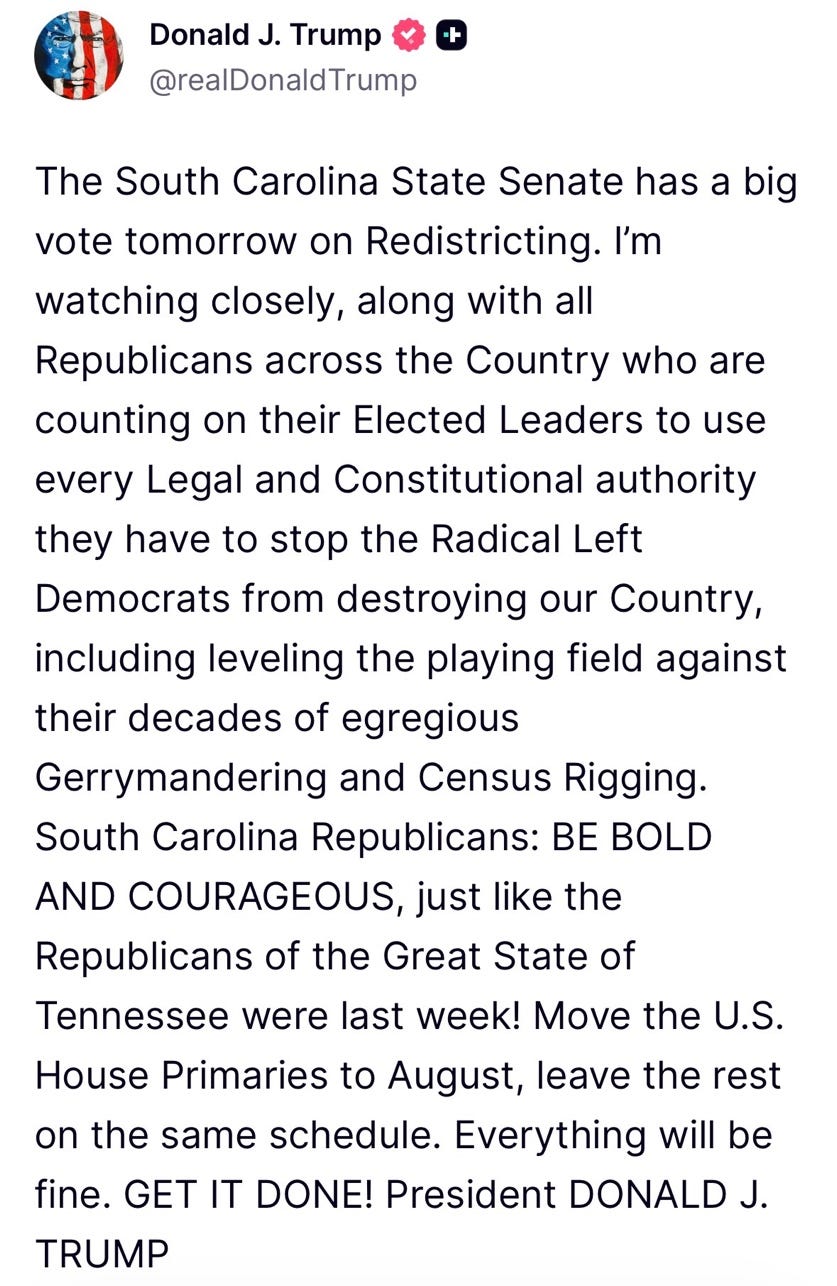
Although his midterm redistricting heist started with asking Texas to redraw its district lines to help him secure additional GOP seats in Congress ahead of this year’s midterms, he didn’t stop there.
Lawmakers here in South Carolina and across the nation have succumbed to pressure from Washington to follow the president’s orders or face political retribution, like Trump-backed opposition in their primaries. Meanwhile, outgoing state Governor Henry McMaster called legislators back into special session to try to force the passage of Trump’s plan after Senate Majority Leader Shane Massey initially blocked the effort. The S.C. House reconvened and passed it. And on Saturday, S.C. Senate Republicans fast-tracked a path to give the bill a second reading.
Politically-motivated tactics like this potentially pave the way for partisan mid-term congressional gains that are designed to preserve Trump’s power while silencing the voices of S.C. voters.
Democrat-led states like Virginia have begun to fight back to try and offset the unfair partisan political gains of the Trump Administration by taking the issue of balanced representation and fair maps to voters. Yet, no sooner than Virginia passed a mid-decade voter-approved redistricting plan, the Virginia Supreme Court struck it down.
Redistricting isn’t just about maps. It’s about power. It’s about race and representation. I believe it’s about courageous leadership and accountability, showcasing how the lack of both exacerbates the broader tension between democracy and incumbent-preservation.
And South Carolina didn’t just get here. Republicans have been gerrymandering our state for decades. One key difference this year is the timing. Changing congressional maps as early voting begins and bypassing legal and procedural safeguards to disenfranchise voters in the middle of a primary election speaks volumes about how far some GOP lawmakers will go to please the president.
Politically-motivated tactics like this potentially pave the way for partisan mid-term congressional gains that are designed to preserve Trump’s power while silencing the voices of S.C. voters.
The Charleston Case
The Charleston congressional gerrymandering case was about Congressional District 1, which includes Charleston and the Lowcountry. After the 2020 Census, state lawmakers moved thousands of Black voters out of Congressional District 1 into Congressional District 6, arguably weakening Black voters’ power in Charleston and making CD-1 safer for Republicans.
A lower federal court agreed and found the map unconstitutional. But in 2024, the U.S. Supreme Court reversed that ruling, saying the challengers had not proven that race, rather than partisan politics, drove the map. In practical terms, the ruling made it harder to challenge maps where race and party overlap, which is especially consequential in South Carolina because Black voters vote heavily Democratic.
Basically, the Court allowed lawmakers to say, “We were targeting Democrats, not Black voters,” even though the voters being moved were disproportionately Black. And with the GOP’s super-majority in the S.C. House and Senate, our state’s hyper-partisan, political imbalance was sealed for the foreseeable future.
In 2026, S.C. Republicans advanced a new mid-decade congressional redistricting effort at Trump’s behest — a proposal that could split my county, Richland County, into three congressional districts and make all seven S.C. congressional districts majority-white and Republican.
How SC’s Congressional Districts Have Shaped Black Political Power
South Carolina’s congressional map has long used Congressional District 6 — stretching across central and eastern South Carolina, including parts of Richland, Charleston, Orangeburg, Sumter, Florence and other counties — as the “container” for Black political power. For 34 years, CD-6 has been South Carolina’s only Democratic district and Congressman Jim Clyburn has been its lone Black Democratic Congressman. Concentrating Black voters in CD-6 instead of allowing us to influence multiple districts has made Congressional Districts 1, 2, 3, 4, 5 and 7 safer for Republicans.
The 2020 presidential election shows the impact clearly: Biden won only CD-6, while Trump carried Districts 1, 2, 3, 4, 5 and 7. So, the issue isn’t just that South Carolina has only one majority-Black district. It’s Black voters’ inability to influence outcomes in other S.C. congressional districts because so many have been packed into one for over three decades.
Impact on Voters
Redistricting has become an insider exercise, dominated by political consultants, lawyers and party politics. For too long, both parties have treated it as a self-preservation strategy. Voters watch from the sidelines as diversity is praised publicly and diminished privately, as incumbents prioritize themselves over the people they represent, as districts become much less competitive, and elected representatives become much less responsive.
Republican leaders use the process to strengthen and preserve power. Democratic leaders often accept “safe” district lines that protect their incumbency, but sacrifice broader voter influence, competition and long-term political growth.
U.S. Senator Lindsey Graham recently stated, “This (Republican Party) is the party of Donald Trump,” noting that anyone who is disloyal to Trump or his agenda will be defeated in their primaries. For S.C, voters, the “party of Donald Trump,” is not the party of the people. Nothing proves that more than his redistricting plan.
Voters watch from the sidelines as diversity is praised publicly and diminished privately, as incumbents prioritize themselves over the people they represent, as districts become much less competitive, and elected representatives become much less responsive.
So What’s Next?
What happens next in South Carolina is likely to be one of the most consequential democracy fights in our state since Reconstruction — not simply because of one congressional district, but because of what this moment says about whether political power is ultimately designed to serve the people of South Carolina or the incumbents who represent them.
Republicans have been clear about the goal: create maps that would likely elect Republicans in all seven of South Carolina’s congressional districts — a Trump mandate that could potentially backfire and make other Republican-leaning congressional districts more competitive for S.C. Democrats.
To be clear, district maps are not neutral. They determine whose calls get returned, whose roads get paved, whose hospitals stay open, whose schools get funded and whose pain becomes politically invisible.
When it comes to redistricting, we must challenge both parties when they trade voter power for incumbent protection, by:
Demanding transparency and public hearings with plain-language explanations and clear justifications to give us a chance to weigh-in and offer input.
Building broad coalitions that refuse to frame redistricting as a Democrat or Black issue. All of us have a vested interest in fair, balanced representation, regardless of race or party affiliation.
Organizing and mobilizing to elect (and hold accountable) leaders who’ll help ensure that our basic living expenses are affordable, quality healthcare is accessible, infrastructure investments are adequate, public schools are fully-funded and communities of interest like Richland County aren’t separated and weakened.
Not allowing CD-6 to continue to serve as the only acceptable home for Black voter-power.
Demanding independent redistricting reform.
To be clear, district maps are not neutral. They determine whose calls get returned, whose roads get paved, whose hospitals stay open, whose schools get funded and whose pain becomes politically invisible.
Because the question isn’t just whether gerrymandering dilutes Black voter-power. It absolutely dilutes Black voter-power. Rural and working-class voter-power too.
And with a political super-majority in both chambers, the S.C. GOP doesn’t need or stand to gain additional power from further disempowering Black, rural, Democratic or working-class voters.
For South Carolina, the implications extend far beyond one seat in Congress. A successful redraw could lock in one-party dominance for at least another decade and diminish the need for candidates to appeal to moderate or independent voters. If similarly-situated voters are split across multiple districts without enough collective voting strength to influence outcomes, our collective ability to shape public-policy diminishes — even if our voting numbers increase.
Hyper-partisan maps and bypassed processes hurt voters of all races because safe districts tend to reward party loyalty over accountability and responsiveness to the people, reinforcing the belief that voters don’t choose their elected officials — elected officials choose their voters.
Much more than gerrymandering, Trump’s redistricting plan seeks to normalize flagrant abuses of political power, where one-party dominance at the state level is used to strengthen presidential power at the federal level. Once S.C. GOP lawmakers give this bill a third reading this week and overtly manipulate our midterm elections for the president’s own partisan political gain, the fragility of our democracy is no longer rhetoric. It’s real.
Let’s vote like we know it.
Former state legislator Mia McLeod was elected to the House in 2010 and the Senate in 2016, representing parts of Kershaw and Richland Counties until declining to seek reelection in 2024. She was the first Black woman to to run for governor of South Carolina, but lost the 2022 Democratic primary to former U.S. Rep. Joe Cunningham. She left the Democratic Party a year later.
Catch up on Frogmore Stew
Frogmore Stew publishes new episodes of the podcast every Tuesday, Wednesday and Friday. Give us a listen on Spotify or Apple Podcasts.
Follow us on Instagram, TikTok, and YouTube. Do you want to write for The Stew? Email Deanna at deanna@frogmorestewsc.com.